You're Grinding Beans in One Machine and Pulling Shots in Another. That's Two Machines Doing One Job.
At $6 per latte, your daily coffee shop habit costs $2,190 a year. That's a round-trip flight to Europe — spent on milk and espresso. The Breville Barista Express BES870XL puts a conical burr grinder, a 15-bar Italian pump, and PID temperature control into a single machine for ~$499. You go from whole beans to a pulled shot without reaching for a second appliance. 26,000+ verified buyers at 4.5 stars. Here's what that all-in-one workflow actually delivers — and where the learning curve bites.
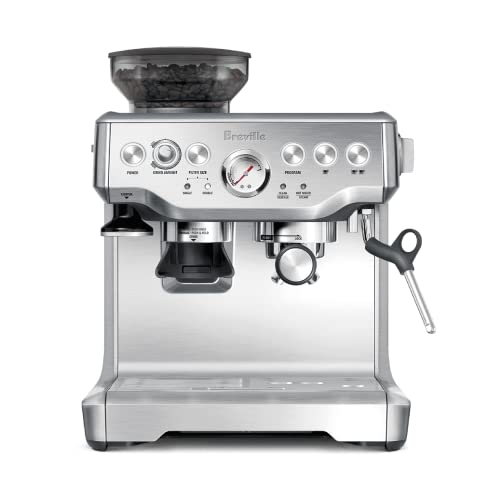
Breville Barista Express BES870XL
Is This Page For You?
- ✓You want a grind-to-cup workflow in one machine — no separate grinder cluttering the counter, no transferring grounds between devices, no guessing whether your grinder and machine are calibrated to each other. Beans go in the hopper, espresso comes out the portafilter.
- ✓You're spending $100+ per month at coffee shops and want to stop — the Barista Express produces genuine espresso with crema, not pressurized imitation. At $0.50–$0.75 per shot with quality beans, the math works out to payback in under three months.
- ✓You want to learn latte art and steam milk properly — the manual steam wand gives you full control over milk texture. It takes practice (expect 2–3 weeks before consistent microfoam), but that hands-on control is what separates real latte art from auto-froth foam.
- ✗You want pod convenience or one-button operation — this is a semi-automatic machine. You grind, dose, tamp, pull, and steam. If that sounds like a chore instead of a ritual, a Nespresso is a better fit for your morning.
- ✗You already own a great standalone grinder — if you have a Baratza Encore, Eureka Mignon, or anything in that class, the built-in grinder becomes redundant. The Breville Bambino Plus pairs better with an external grinder and gives you automatic milk frothing instead.
How It Compares: Barista Express vs. Bambino Plus vs. Gaggia Classic Pro
| Feature | Barista Express | Bambino Plus | Gaggia Classic Pro |
|---|---|---|---|
| Built-in grinder | Yes (conical burr) | No | No |
| Portafilter size | 54mm | 54mm | 58mm (commercial) |
| PID temperature control | Yes (built in) | Yes | No (mod available) |
| Steam wand | Manual | Automatic | Manual (Panarello) |
| Price (typical) | $499–$550 | $399–$450 | $399–$449 |
| Total cost with grinder | $499–$550 | $549–$650+ | $549–$649+ |
| Best for | All-in-one simplicity | Already own a grinder | Mod-friendly platform |
The Barista Express is the only machine here where the total cost includes a grinder. The Bambino Plus and Gaggia Classic Pro both require a separate grinder purchase ($100–$200+) to produce consistent espresso.
What 26,000+ Verified Buyers Report
The conical burr grinder is not a token add-on. Reviewers consistently report that dialing in grind size around setting 5 for medium roasts produces proper espresso with crema and body. The dose-control feature grinds directly into the portafilter and stops automatically at your set amount, which eliminates the mess of transferring grounds. The grinder has both an outer dial (coarse adjustment, 8 positions) and an inner burr adjustment for fine-tuning, giving you more precision than the "8 settings" spec suggests.
Most buyers report a 1–2 week dialing-in period before they consistently pull good shots. The pattern is always the same: first shots run too fast or too slow, you adjust grind size by one click, try again. Once you find your setting for a given bean, you can repeat it reliably. The dual-wall (pressurized) baskets included in the box are forgiving while you learn. Switch to the single-wall baskets once your technique is solid — that's where the real espresso quality lives. Aim for 25–30 seconds for a double shot as your starting benchmark.
This is a manual wand, not an automatic frother. You control depth, angle, and timing. Reviewers who stick with it for 2–3 weeks report producing latte-art-quality microfoam — the silky, glossy texture that pours, not the dry foam that sits on top. The technique: start with the tip just below the surface to introduce air for 3–5 seconds, then submerge deeper to create a whirlpool that integrates the foam. Whole milk is most forgiving while you learn.
Reviewers with 2–4 years of daily use report the machine still performing well, with one caveat: you have to descale it. Breville includes cleaning tablets and a descale alert, but reviewers who skip maintenance report reduced steam pressure and slower heating. The grinder burrs also benefit from occasional cleaning with a brush to prevent oil buildup. Treat it like a $500 machine and it lasts. Neglect it and the performance degrades within 12–18 months.
Specs at a Glance
| Grinder | Integrated conical burr, dose-control (18 click settings) |
| Pump | 15-bar Italian-made (9-bar at the group head) |
| Boiler | Stainless steel thermocoil with PID |
| Portafilter | 54mm stainless steel |
| Water tank | 67 oz (2L), removable |
| Steam wand | Manual, 360-degree swivel |
| Baskets included | Single-wall (1-cup, 2-cup) + dual-wall (pressurized) |
| Dimensions | 13.2" H x 12.5" W x 15.8" D |
| Weight | ~23 lbs |
| Voltage | 120V / 1600W |
| Warranty | 2-year limited (Breville) |
Pros and Cons
- ✓ Built-in conical burr grinder eliminates a $150+ separate purchase
- ✓ PID temperature control for consistent extraction
- ✓ Dose-control grinding stops automatically at your set amount
- ✓ Both single-wall and dual-wall baskets included
- ✓ Pays for itself in under 3 months vs. daily coffee shop visits
- ✓ 26,000+ reviews validate long-term reliability
- ✗ Manual steam wand requires 2–3 weeks of practice
- ✗ 54mm portafilter (not commercial 58mm standard)
- ✗ Large footprint: 15.8" deep, 23 lbs
- ✗ Single boiler — must wait between pulling shots and steaming milk
- ✗ Grinder is redundant if you already own a quality standalone grinder
Frequently Asked Questions
Do I need a separate grinder with the Breville Barista Express?
How long does the Barista Express take to pay for itself?
Is the Barista Express good for latte art?
What grind setting should I start with?
How does the Barista Express compare to the Gaggia Classic Pro?
More Espresso Machine Reviews
Get our best picks in your inbox
No spam. Just honest Amazon reviews, once a week.
Unsubscribe any time. We'll never sell your address.