Best Tower Fans 2026 — 4 DREO Models for Every Room and Budget
The tower fan you've had for three years sounds like a desk drawer being opened on maximum speed. The cheap one that replaced it either doesn't move enough air or runs loud enough to cover the TV. DREO has spent the last three product generations solving this exact problem, and they've gotten genuinely good at it — their lineup covers bedrooms, large rooms, smart-home setups, and price-sensitive buyers in four distinct models.
Here's the short version: if you want quiet sleep mode at under $90, get the standard 42-inch. If you need to cover a larger room, get the 120° model. If you have smart-home devices, get the WiFi model. If you want the best-rated current DREO, get the 2026 upgrade.
Quick Comparison
| Fan | Best For | Price | Stars | Key Feature |
|---|---|---|---|---|
| DREO 42-Inch Standard | Best all-around / bedroom | ~$75–$90 | 4.4★ | 9 speeds + sleep mode, 4,200 reviews |
| DREO Cruiser Pro 120° | Large rooms / open plan | ~$85–$100 | 4.4★ | 120° oscillation vs standard 90° |
| DREO Smart WiFi | Smart-home setups | ~$95–$110 | 4.4★ | Alexa + Google Home + app scheduling |
| DREO 2026 Upgraded | Best current model | ~$80–$100 | 4.5★ | Enhanced mid-speed airflow + smoother sleep ramp |
Best All-Around — Most Reviews
1. DREO 42-Inch Standard — ~$75–$90
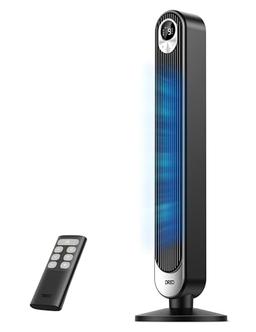
The most reviewed DREO tower fan at 4,200+ ratings and 4.4 stars. Nine speeds close the gap between "barely moving air" and "too cold" that ruins 3-speed fans. Sleep mode drops to ~25 dB and dims the display completely — the bedroom use case it was built for. Remote included, no app required.
The trade-off: 90° oscillation only, no WiFi. Both limitations are addressable by spending $10–30 more on the specialized models.
Best for Large Rooms
2. DREO Cruiser Pro 120° Oscillation — ~$85–$100
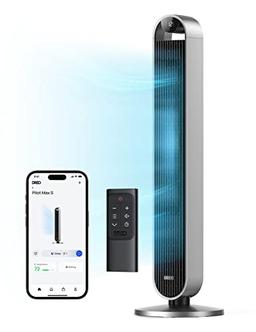
The 120° arc is one-third wider than standard 90° oscillation. In a 300–400 sq ft living room or open bedroom, that difference means both ends of a couch, or both sides of a king-size bed, get airflow on the same pass. If you've been repositioning your fan into corners trying to cover more space, this is what you actually needed.
Six speeds (vs. nine on the standard) — the speed count tradeoff for wider coverage is worth it in large rooms.
Best for Smart-Home Users
3. DREO Smart Tower Fan — ~$95–$110
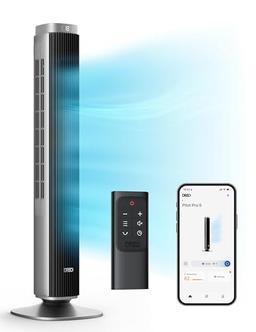
The WiFi model adds Alexa and Google Home voice control, app scheduling, and remote access. "Alexa, set fan to speed 3" at lights-out is the use case that earns this fan its premium over the standard. App scheduling — set it to turn on 20 minutes before you get home — is the second one.
Physical remote still included. WiFi connectivity is additive; all physical controls work offline. 2.4 GHz WiFi required (most home routers).
Best-Rated Current Model
4. DREO 2026 Upgraded — ~$80–$100
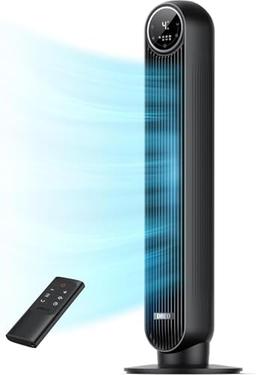
The 2026 generation improved mid-speed airflow efficiency (more air at speeds 4–6 without added noise) and refined the sleep mode ramp-down to be gradual rather than a sudden step. It carries the highest rating in the DREO tower fan line at 4.5 stars on 2,100+ reviews.
If you're buying a DREO for the first time and want their best current model without smart features, this is it.
Tower Fan vs. Window AC — When a Fan Is Enough
A DREO tower fan uses 35–45 watts. A portable or window AC unit uses 500–1,500 watts. Running a tower fan at night costs roughly $1–2 per month at typical electricity rates. Running an AC unit adds $30–80+ per month per room.
For most people: if outdoor temperatures drop below 75°F at night, a tower fan on sleep mode is enough. If indoor temperatures stay above 80°F even at night, pair a tower fan with a window unit — the fan distributes the conditioned air more effectively and lets you run the AC at a higher set point (saving energy). The two tools work better together than either does alone.
Frequently Asked Questions
Is a tower fan better than a window fan for cooling a bedroom?
How much does a tower fan actually save vs. running AC?
What speed should I use a tower fan on while sleeping?
Our Top Pick: DREO 42-Inch Standard
For most buyers — bedroom use, one or two people, no smart-home setup — the standard DREO 42-inch at ~$75–90 is the right call. 9 speeds, sleep mode, remote, 4,200 buyers. Quiet enough to sleep next to.
Check Current Price on Amazon →Individual Reviews
Get our best picks in your inbox
No spam. Just honest Amazon reviews, once a week.
Unsubscribe any time. We'll never sell your address.